A blog about life, study and more at Franklin University Switzerland, written and curated by current students.
Academic Travel
Get link
Facebook
X
Pinterest
Email
Other Apps
-
This week is beyond busy!! I have work + five midterms + packing + cleaning to do! But the good news is that I can survive this week because I know that next week I am headed to Rome and Southern Italy!!
This week on Adventures at Franklin, we're going to be talking about cantons - the geographic regions that make up Switzerland. If you're planning to live in Switzerland, it's important to know about the different cantons because each one has varying laws, holidays and even languages . What even is a canton? You might ask. Well, a canton is similar to a state, like those found in countries like the United States and Mexico. However, each Swiss canton has its own constitution that has been federally approved. There are 26 cantons in total , among them several half cantons . Half cantons are cantons that split at some point. They mainly differ from other cantons in that they only send one member to the upper house of parliament, rather than two. Franklin University Switzerland is located in Ticino , the only canton in Switzerland where Italian is the only official language. Although Italian is spoken in neighboring Graubünden as well, it has four official languag...
Something that many people unfamiliar with Switzerland do not know is that it is a multilingual country. Switzerland has four national languages : German, French, Italian, and Romansh. Contrary to what some people believe, this does not mean that every Swiss person can speak all four languages. In fact, although many (if not most) people are multilingual, they tend to stick to the language of their region when it comes to communicating and consuming media. Every Franklin student knows the value of picking up a few words of the many languages they encounter — and when it comes to getting around in the Italian-speaking region of Switzerland, where Franklin is located, it's definitely useful to have some terms at hand. By Marco Zanoli (sidonius 13:20, 18 June 2006 (UTC)) - Swiss Federal Statistical Office; census of 2000, CC BY-SA 3.0, https://commons.wikimedia.org/w/index.php?curid=875011 I thought I would use this post to provide some linguistic basics when it co...
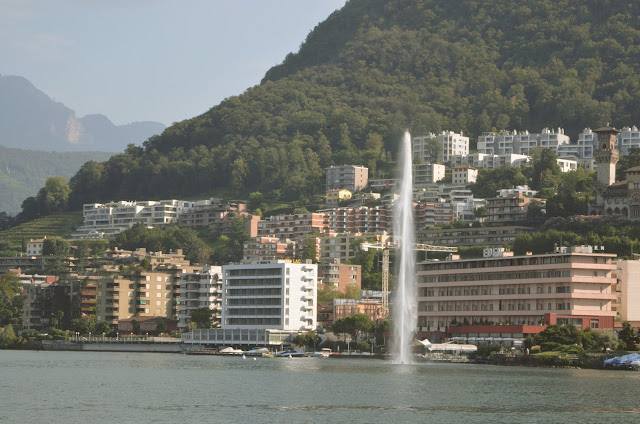
Hello! Welcome to a new series called Swiss Cities in Depth . I'm interested in highlighting some of the great places Switzerland has to offer by featuring some of its cities here on the Adventures at Franklin blog. Since the majority of the country is accessible within several hours by train, these cities are also excellent to visit for a day or a weekend. I thought that the best way to begin would be by writing about the city that Franklin calls home — Lugano. Technically, Franklin is located within a Comune (municipality) called Sorengo. However, Sorengo lies within the metropolitan area of Lugano, the largest city in Canton Ticino. Geneva isn't the only city with a "Jet d'Eau" - Lake Lugano has one too. Ours is located in Paradiso, another Luganese municipality. Lugano has existed, albeit in a less developed form, for over 1000 years. There is proof the area was inhabited dating back at least to the 10th century, and artifacts discovered h...


Comments
Post a Comment